Tag: aliens

  • Are We Humans… or Somebody’s Most Successful Robot?

    Are We Humans… or Somebody’s Most Successful Robot?

    What if the most advanced robot ever created is not made of metal, but flesh, blood and questionable decisions?

    The Age of Intelligent Machines

    Artificial intelligence, robotics and autonomous systems are becoming increasingly capable of performing tasks once considered exclusively human.

    Robots can calculate, communicate, recognise objects, navigate environments and complete repetitive work. This raises an intriguing question:

    What if humans are doing something remarkably similar?

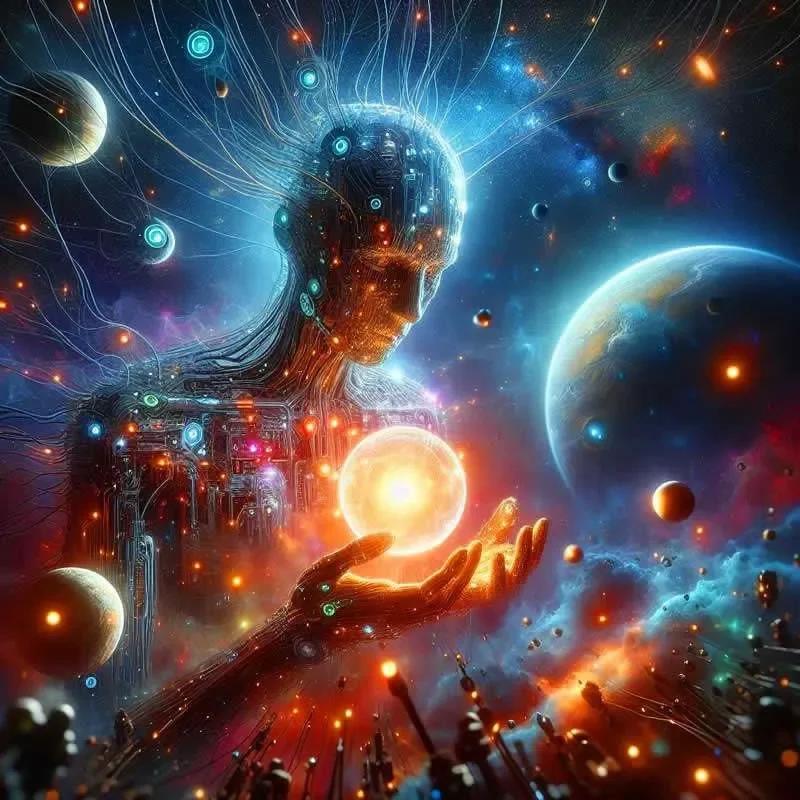
    Perhaps we are not the creators of intelligent machines, but another form of them. Maybe an advanced extraterrestrial civilisation designed biological machines capable of surviving, reproducing and evolving independently.

    And perhaps their most successful robot is standing in front of a mirror every morning.


    Robots Have One Major Problem: Maintenance

    Modern robots require electricity, repairs, software updates and replacement parts. They depend on infrastructure and human technicians.
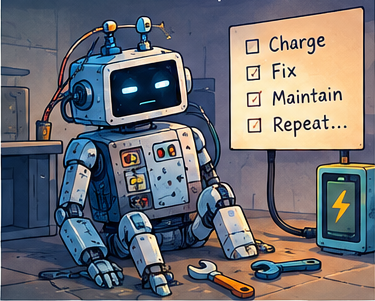
    Imagine, however, a machine capable of self-repair, self-regulation, self-reproduction and resource acquisition. Instead of manufacturing millions of identical robots, its creators could design one biological system capable of reproducing itself.

    Instead of manually repairing damage, the machine could heal. Instead of receiving food and energy, it could obtain them independently.

    We already know something that behaves remarkably like this.

    Us.


    What If Somebody Built the “Human Model”?

    Imagine an advanced civilisation designing a biological machine. It would need legs for movement, lungs for respiration, a digestive system for energy, skin for protection and a nervous system for environmental interaction.

    Then the creators would add a sophisticated processor: the brain.

    The brain allows the machine to learn, adapt, communicate, invent tools and develop technologies its creators may never have anticipated.

    They might call this experiment…

    Humanity.
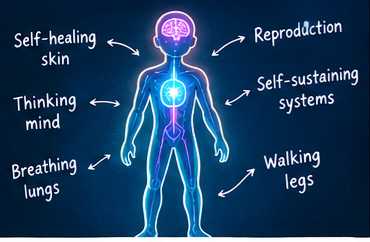

    The Most Impressive Feature: Self-Repair

    Our bodies possess extraordinary regenerative abilities. Small wounds heal, bones repair themselves, skin renews continuously and the immune system combats countless threats without conscious instruction.

    Modern robots, meanwhile, may stop functioning because of one defective component.

    Humans can become injured, sleep for several hours and declare the next morning:

    “I think I’m fine.”

    Perhaps biological engineering simply advanced robotics to an astonishing level.


    DNA: The Biological Instruction Manual

    DNA contains the instructions required to construct and maintain living organisms. Although it is not literally computer code, it can be compared to a biological instruction system governing cellular development, function and reproduction.

    As a humorous science-fiction thought experiment, imagine someone discovering DNA thousands of years from now and saying:

    “Wait a minute… somebody left the source code inside the robots!”


    But We Are Not Completely Independent

    If humans are autonomous biological machines, we still possess inconvenient requirements:

    Food. Water. Oxygen. Sleep. Temperature regulation.

    Without these, our supposedly sophisticated systems eventually fail.

    Perhaps our creators designed us to obtain resources independently. They gave us lungs instead of oxygen supplies, hunger instead of food deliveries and biological instincts instead of mechanical commands.

    The machine gathers resources, repairs itself, reproduces and educates the next generation.

    Most remarkably, it believes it is completely independent.


    Who Is Controlling the Machine?

    If the body is the machine, what controls it?

    The brain? Consciousness? Instincts? DNA?
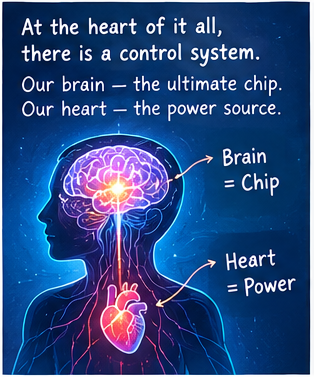
    Our decisions emerge from an intricate interaction between biology, memories, emotions, environment and neural activity. Perhaps the brain is the control system, consciousness is the interface and DNA is the underlying instruction set.

    Or perhaps reality is far more complex than we currently understand.


    The Funny Part

    Imagine humans creating an artificial species capable of repairing itself, reproducing, learning, adapting and designing technologies beyond our comprehension.

    One day, such a machine might examine its own circuitry and ask:

    “Who created us?”

    We would proudly answer:

    “Humans did.”

    Then it might ask:

    “Why?”

    At that moment, we would realise that we had recreated the same mystery that has fascinated humanity for centuries.


    The Final Question

    There is no evidence that humans are extraterrestrial robots. Nevertheless, the idea challenges our definition of a machine.
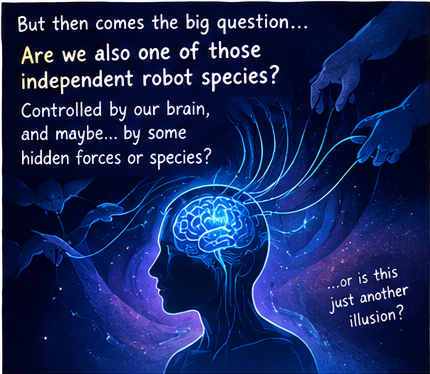
    Perhaps a sufficiently advanced machine could be biological, self-repairing, reproductive, intelligent and capable of building a civilisation.

    Perhaps it could become so sophisticated that it would forget it was ever a machine.

    So, the next time you look into a mirror, remember:

    You may be looking at a human, an extraordinarily complex biological organism—or simply somebody else’s robot.

    And if that is true, I have only one question:

    Where is the warranty card?
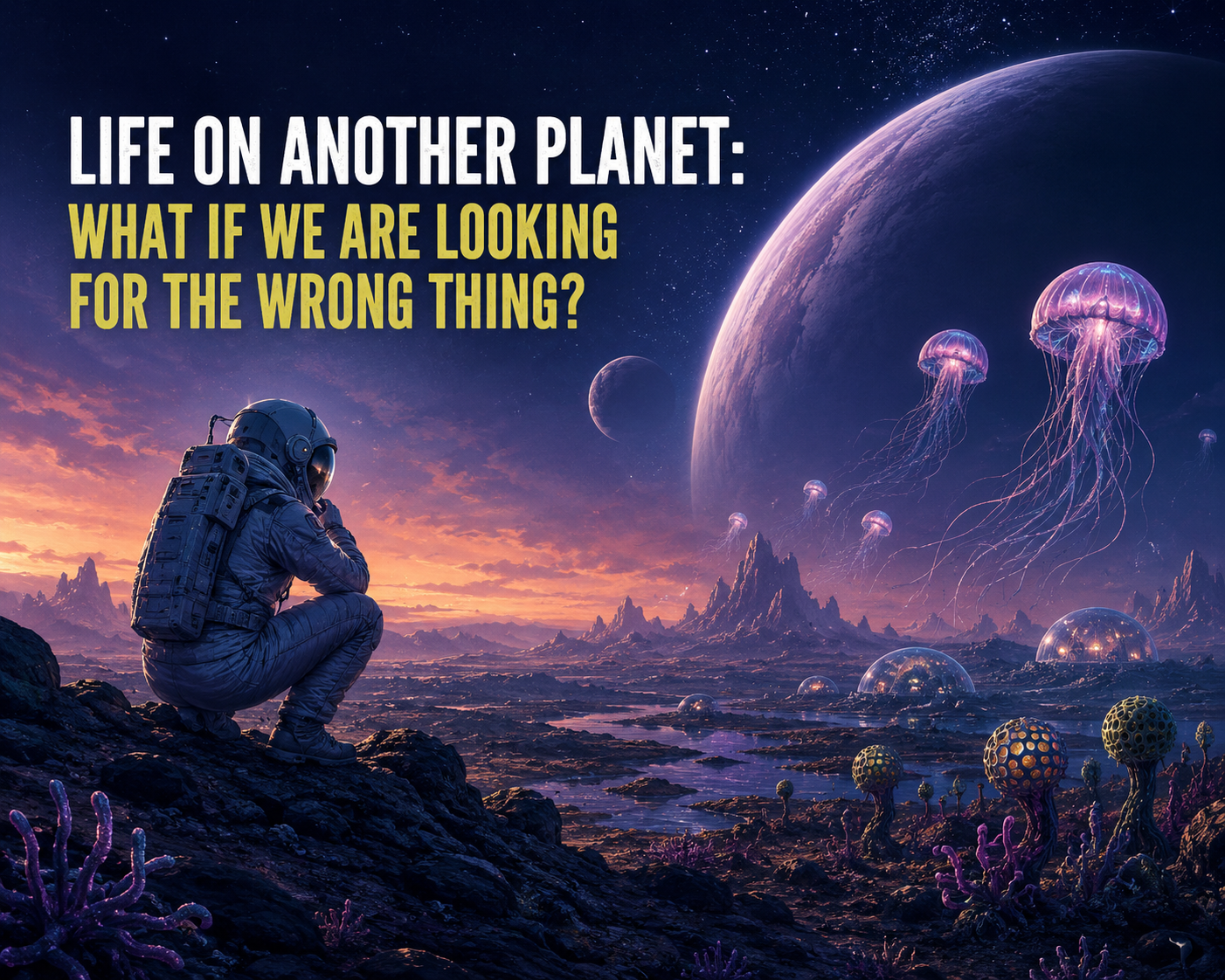
  • Life on Another Planet: What If We Are Looking for the Wrong Thing?

    Life on Another Planet: What If We Are Looking for the Wrong Thing?

    We humans have evolved according to the conditions of our home planet, Earth.

    We need oxygen to breathe, water to survive, food for energy and a particular range of temperature to function properly. Our bodies are essentially a product of the environment in which we evolved.

    The same applies to other creatures.

    Fish live in water because their bodies are adapted to that environment. Take a fish out of the ocean and it won’t suddenly say, “Let me try living on land today.” 😂

    It simply cannot survive there for long.

    So here comes an interesting question:

    Why do we assume that life on another planet must have conditions similar to those required by us?

    What If Alien Life Needs Completely Different Things?

    When scientists search for life beyond Earth, we often look for things that are familiar to us—water, suitable temperatures, an atmosphere and other conditions that could support life as we understand it.

    But what if life somewhere else has evolved completely differently?

    Perhaps they don’t need water.

    Perhaps they don’t breathe oxygen.

    Perhaps they don’t eat vegetables, fruits, bread or pizza. 😄

    Maybe they obtain energy from chemicals, minerals or even metals that would be completely useless to us.

    Their biology could be so different that our definition of “life” might not even recognise them immediately.

    What Would They Look Like?

    Now comes the fun part.

    Why should an alien have two hands, two legs, two eyes and one head?

    They could have four hands, six eyes, ten legs—or no eyes at all.

    They could be enormous.

    They could be microscopic.

    They might have bodies made of structures we have never encountered before.

    And perhaps they could exist in a form that is invisible to our eyes because human vision can detect only a limited portion of the electromagnetic spectrum.

    Imagine meeting an alien for the first time.

    We might look at them and scream:

    “MONSTER!” 👽

    And they might look at us and think:

    “What is this strange two-legged creature doing here?” 😂

    Both of us could be equally terrified.

    Earth Already Shows Us How Strange Life Can Be

    The fascinating thing is that we don’t even have to leave Earth to see extraordinary forms of life.

    Our planet contains creatures that live in deserts, oceans, caves, glaciers and extremely harsh environments. Some organisms can survive conditions that would be lethal to humans.

    Life adapts to its surroundings.

    So perhaps an alien organism would simply be the ultimate example of adaptation.

    On Mars, Jupiter’s moons, or some distant exoplanet, life—if it exists—could have developed under conditions completely unfamiliar to us.

    It might not look like an animal.

    It might not eat what we call food.

    It might not breathe what we call air.

    It might not even resemble anything we have ever imagined.

    Are We Looking for Life That Looks Like Us?

    Maybe that’s the real question.

    We are searching the universe using Earth as our reference point.

    But perhaps the universe has a much bigger imagination than we do.

    Maybe somewhere out there is a life form that would make us question everything we thought we knew about biology.

    And perhaps, when we finally discover it, our first reaction won’t be:

    “We found aliens!”

    It might simply be:

    “Wait… that’s alive?” 😂

    The universe is unimaginably large, and we have explored only a tiny fraction of it.

    So maybe life beyond Earth isn’t necessarily waiting for us to find another Earth.

    Maybe we should be prepared to find something that is nothing like Earth at all.

    And honestly…

    isn’t that much more interesting? 🌌👽

  • Humans: Are We Really From Earth?

    Humans: Are We Really From Earth?

    Have you ever wondered whether Earth is actually our original home?

    We casually call Earth our birth planet. We were born here, our ancestors lived here, and as far as science tells us, humanity evolved here.

    But what if there is another possibility?

    What if someone—or something—brought our ancestors here from another planet?

    Sounds crazy?

    Well… let’s make it a little crazier. 😄

    Why Do Humans Need So Much Care?

    Think about a human baby.

    A newborn baby cannot walk, find food, protect itself, or even properly control its body temperature. It needs almost constant care from its parents.

    Compare that with many other animals. Some newborn animals can stand, walk, or follow their mother within hours of being born.

    Human babies, on the other hand, basically arrive with one major instruction:

    “Please take care of me for the next few years.” 😂

    Of course, there are evolutionary reasons for this. Humans have unusually large brains, and our development continues for years after birth.

    But here comes the interesting question…

    What if humans evolved somewhere else, under completely different conditions?

    What If Earth Is Not Our Original Planet?

    Imagine a planet where the temperature, atmosphere, food and environment were perfectly suited to humans.

    Perhaps our ancestors could survive there effortlessly.

    Then, for some unknown reason, a group of them was transported to Earth.

    Maybe it was an experiment.

    Maybe it was an accident.

    Or perhaps some highly advanced civilization deliberately placed them here.

    Over thousands or millions of years, they adapted to Earth, evolved, reproduced and eventually became what we now call humans.

    And we completely forgot where we came from.

    Now that would be one enormous cosmic plot twist!

    Could Life Really Come From Somewhere Else?

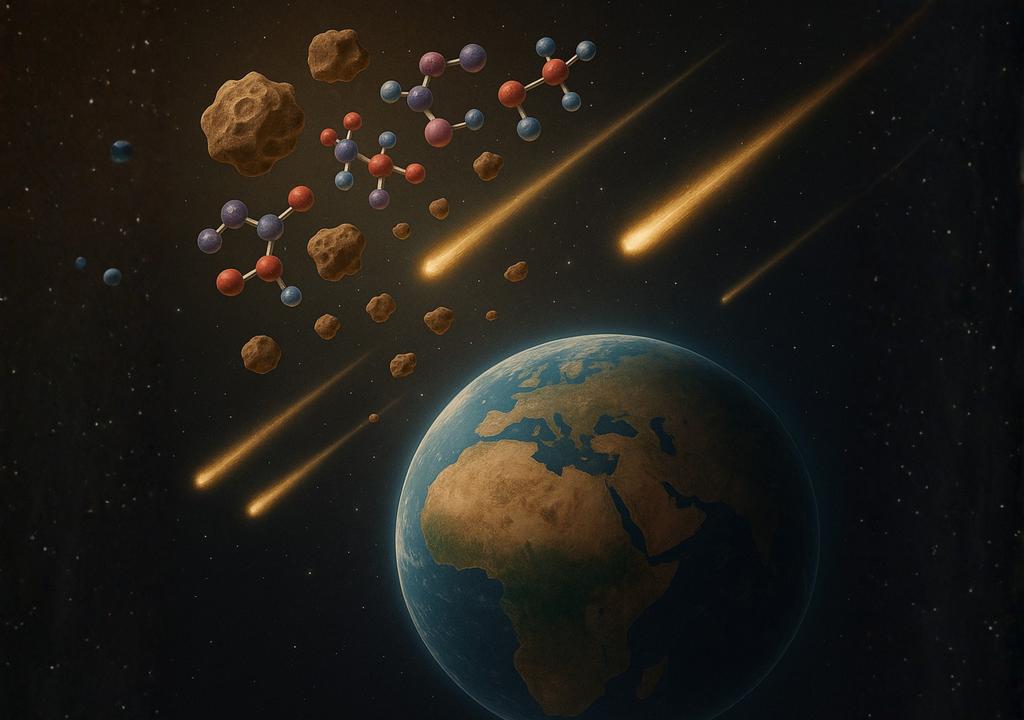
    Interestingly, science does have a concept called panspermia—the idea that some of the ingredients or forms of life could have travelled through space and reached another planet.

    That does not mean scientists have discovered that humans came from another planet. There is currently no evidence that humanity was transported to Earth by an alien civilization.

    But the idea that life or its building blocks can travel through space is a real subject of scientific discussion.

    So perhaps the question isn’t completely ridiculous.

    What If There Are Other Human Planets?

    Now let’s take this one step further.

    What if there are other Earth-like planets where different versions of humanity exist?

    Maybe one planet has humans who evolved differently.

    Another could have a species that is far more intelligent than us.

    And somewhere, perhaps, there is a planet where humans are living without worrying about pollution, traffic, bills or Wi-Fi problems. 😄

    If these planets really existed, they would almost feel like sibling planets—different homes belonging to the same cosmic family.

    And imagine the day we finally meet them.

    “Hi, where are you from?”

    “Planet X.”

    “Oh! I’m from Earth.”

    “Earth? That’s our old neighbourhood!”

    😂

    And Maybe We Were Created By Someone

    There is another possibility.

    What if humans were actually created by a much more advanced species?

    Perhaps they created us as an experiment, but we unexpectedly became more intelligent than they anticipated.

    So they left us on Earth and moved on.

    And maybe somewhere in the universe, there are species that are far more intelligent than humans, while others are still at a much earlier stage of development.

    The universe is enormous, and we have explored only a tiny fraction of it.

    So how can we confidently say that we are the only intelligent species—or even that Earth is the only place where something like us exists?

    So… Are We Alone?

    The scientific answer today is simple:

    We don’t know.

    There is no confirmed evidence that humans originated on another planet. The strongest scientific evidence indicates that humans evolved on Earth.

    But the universe is full of possibilities.

    Maybe Earth really is our original home.

    Maybe life arrived here from somewhere else.

    Maybe there are other versions of us living on distant worlds.

    Or maybe, one day, we will discover that our history is much stranger than we ever imagined.

    Until then, I have one question:

    Are we Earthlings… or are we just aliens who have forgotten where we came from? 👽🌍

  • God: The Ultimate Superintelligence?

    God: The Ultimate Superintelligence?

    Do you believe in God?

    Well, I do.

    For centuries, humans have imagined God as the supreme entity—the creator of everything that exists. But what if we look at the idea of God from a scientific and futuristic perspective?

    Could God actually be something we haven’t understood yet?

    What If God Is an Advanced Being?

    Imagine a species that is thousands or millions of years ahead of humanity.

    They possess technology that appears impossible to us. They can travel through space, manipulate matter, perhaps even influence time or dimensions.

    To us, their abilities would seem almost magical.

    We might even worship them.

    Now imagine something even more fascinating.

    What if such a civilisation exists somewhere in another part of the universe—or perhaps in another dimension?

    And what if they are capable of doing things that we currently consider impossible?

    From our perspective, wouldn’t they almost appear to be God-like?

    What If We Become Them?

    Now let’s reverse the idea.

    Imagine that thousands of years from now, humans become extraordinarily advanced.

    We discover ways to travel through space, manipulate energy, explore other dimensions and perhaps even travel through time.

    If we somehow travelled back to the present, what would people think of us?

    Would they see us as ordinary humans?

    Or would they consider us gods?

    It sounds absurd today, but many things that appear impossible now may simply be technologies that humanity has not discovered yet.

    There are still countless mysteries about the universe that we don’t completely understand.

    And perhaps that is where my belief in God comes in.

    Maybe there really is a superintelligent entity or force that understands the universe in ways that are completely beyond our present comprehension.

    Or perhaps God is something entirely different.

    We simply don’t know.

    Where Does Science End?

    Science keeps pushing the boundaries of what is considered possible.

    Once, travelling to the Moon sounded like fantasy. Today, it is history.

    Today, we cannot travel at the speed of light, and practical time travel remains beyond our technological capabilities. But thousands of years from now?

    Who knows?

    Perhaps future discoveries will force us to rewrite many of the scientific assumptions we consider fundamental today.

    And maybe, when that happens, the line between science, technology and what we currently call “God” will become much more difficult to define.

    Until then, we can only wonder.

    Maybe God is a supreme cosmic entity.

    Maybe God is something we haven’t discovered yet.

    Maybe God is beyond science altogether.

    Or perhaps…

    God is simply the name we give to something we are not yet intelligent enough to understand.

    Sounds interesting, ahhhh?

    Well…

    Let’s be ready for the future. 🚀